
Tata Trusts with Centre for Micro Finance (CMF) as the nodal agency in Rajasthan, have designed a five year (2015-2020) integrated multi-thematic project ‘Transformation Initiative’ (TI), which is currently being implemented in four blocks of South Rajasthan (Bali in Pali district, Abu Road & Pindwara in sirohi district and Sayra in Udaipur district) covering approx. 70,000 households and 350,000 population. The initiative seeks to demonstrate proof of concept of transformational change in the quality of life of community through integration of livelihoods, drinking water and sanitation, education and nutrition initiatives.
It was envisaged that there is requirement to develop a model village to demonstrate a proof of concept in transforming a tribal village to a ‘model village’ in a 3 year time span (2016-2019) with flexible resource availability and active community participation.
About Kooran
Kooran is one of the revenue village of Kuran Panchayat situated in north eastern part of Bali block and is about 50 KM away from Block Office. It is a 100 % tribal habituated village of Block Bali of District Pali in western Rajasthan. These Tribes are named as Garasiya and Bhil tribes. The village is divided into four Hamlets known as Fali. There are 425 families living in the village. Total population of the village is 1700, and out of 425 families 365 families fall under BPL (Below Poverty Line) category. Around 39% people are educated in the village. There are one Anganwadi and mini Anganwadi center, one secondary school, Panchyat Bhawan and Atal Seva Kendra in the village.
The average land holding of the villager is around 2-3 Bigha per family (1 Hectare = 6.25 Bigha). Maize in kharif and wheat in Rabi are the major crops that farmer grows. Majority of land is rain-fed hence the opportunity of Rabi crop cultivation is with only few farmers.There are 19 Women Self Help Groups (SHGs) covering 312 members, which are also federated into Village Organization named “Jagruti Mahila Gram Sanghathan”.
CMF and our partner Ambuja Cement Foundation have been working in this village to promote women led Self Help Groups (SHG) and its higher institution.
Objective of Model Village
The model village that will be developed with support of TATA AIG would be showcased to the state government and other donors for replication across the Transformation Initiative. The process would be documented and would also serve as a knowledge base for TATA AIG’s CSR programme and inform its future strategy.
Key Components of Programme
Transformation initiative is a multi-thematic programme under which the model village initiative comes which is comprised of different components which are as follows:
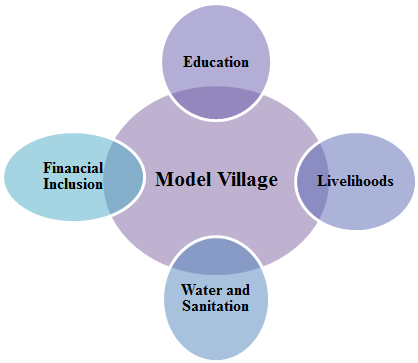
Education: Education interventions in Kuran village are planned for improving quality of pre-school, primary, middle school and educating and mainstreaming out-of-school children and adolescents. Major components of CMF’s Education programme are:
Pre-School
- Strengthen Anganwadi to ensure quality early childhood education (ECE) and demonstrate quality practices.
- Enable conducive environment for school readiness and teaching learning in the Anganwadi.
Primary School
- Strengthen Primary School component (grade 1-5) to improve in learning outcomes of the students, high retention and enrollment.
- Develop literacy skills and a habit of reading among grade 1-5 children
- Strengthen teaching learning practices of Science, Mathematics and English in upper primary school component (grade 6-8).
- Capacity building of teachers
School Dropouts
Demonstrate an integrated and comprehensive approach in Kuran village for educating and mainstreaming out of school children and adolescents by significantly reducing school drop-out. Different activities such as Life Skill Education, Training of youth groups, Vocation preparedness training with youth etc. has been planned for educating the out of school children.
Digital Literacy
- Community Information Resource Center (CIRC) for digital literacy and services such as photocopy, scanning and printing the documents, Internet browsing etc.
- Provided tablets to school equipped with eLibrary app/eReader to ensure access to age appropriate, quality children’s literature through technology for developing reading skills and promote habit of reading.
Livelihood: CMF formulated transformation initiative with the innovations to improve livelihoods and builds livelihood clusters. Our thematic focus is water resource management, horticulture, agriculture, in addition to self-help groups that are formed and aggregated into a federation in almost all project locations.
The five areas of inputs or interventions required in the field to establish a livelihood cluster:
- Soil and water related: soil health, access to water, etc.;
- Appropriate technology related to seed, breed, pest and disease control, preservation and processing post-harvest.
- Access to market
- Credit access
- Organizing the poor and investing in its leadership and management capacity at all levels. It is a complex business as it takes a while and the new arrangements have to fight against the established ones.
CMF build on the field experience and train staff and community, and where possible share our knowledge to build other capacity and influence larger systems, beginning from district and going up to the state and the centre.
Water, Sanitation and Hygiene (WASH): Access to safe drinking water and sanitation are critical for ensuring good health & quality of life for any household. Safe water and sanitation are also integral to the nutrition component of the Transformation Initiative, as a strategy to prevent water borne diseases and infections among children, which could lead to poor health and fall back into malnutrition.
This has ABC approach:
ACCESS: Facilitate sustainable access to and use of WASH facilities, products and services: Households and Public Institutions.
BEHAVIOUR: Mobilize communities, raise awareness, trigger community led Behaviour change for WASH.
CAPITAL: Facilitate access to credit through SHGs, Banks, develop entrepreneurs for WASH services and develop market linkages.
Financial Inclusion: The core of CMF’s work is to capacitate Self-Help Groups (SHGs) and their federations to serve their members by providing a range of financial and farm livelihood support services and thereby enable them to lead a better quality of life.
To organize community around Self-Help Groups in tribal blocks under Transformation Initiative, CMF replicates the model of Sakh se Vikas programme. CMF has worked on the capacity building of marginalized women farmers by building capacities of SHG federations and leading NGO’s in Rajasthan. CMF has introduced simple and easy steps to understand IEC material for the usage of community as well as the promoter organizations.